Installation
Download
You can download the latest version of the Nextcloud Desktop Synchronization Client from the Nextcloud download page. Clients are available for Linux, macOS, and Microsoft Windows.
You will also find links to source code archives and older versions on the download page.
Supported server versions
Each desktop client release supports the latest three stable Nextcloud server major versions at the time of release. See the Nextcloud Server release schedule for supported major versions.
System Requirements
Windows 10+ (64-bits only)
macOS 12.0+ (64-bits only)
Linux (Ubuntu 24.04 or openSUSE 15.5 or Alma 8 or …) (64-bits only)
For Linux distributions, we support, if technically feasible, the current LTS releases. For BSD, we support them if technically feasible, but we do not test them.
Note
We do not support Citrix.
We will do our best to advise Citrix users from the desktop client point of view.
We will fix issues that are also reproducible on the standard supported systems.
Everything else is outside of our scope.
Install on macOS and Windows
Installation on macOS and Windows is the same as for any other software application: download the program and then double-click it to launch the installation, and then follow the installation wizard. After it is installed and configured the desktop client will automatically keep itself updated; see The Automatic Updater for more information.
For administrator-focused deployment options such as advanced Windows MSI configuration, non-interactive account provisioning, and command-line wizard preconfiguration, see the Admin Manual chapter on desktop client deployment and setup.
Install on Linux
For Linux, Nextcloud officially provides the desktop client as an AppImage on the Nextcloud download page.
Some Linux distributions also provide the Nextcloud desktop client through their package managers. These packages are maintained by the distribution or community, not by Nextcloud. If you prefer a package-managed installation, refer to your distribution’s documentation.
Linux users must also have a password manager enabled, such as GNOME Keyring or KWallet, so that the desktop client can log in automatically.
Initial Setup
After installation, the initial setup wizard is triggered. In the setup wizard, you can log in to your server, create an account with a provider, and configure which folders to sync. The wizard will guide you step-by-step through the essential configuration options and basic account setup.
First, you need to enter the URL of your Nextcloud server.
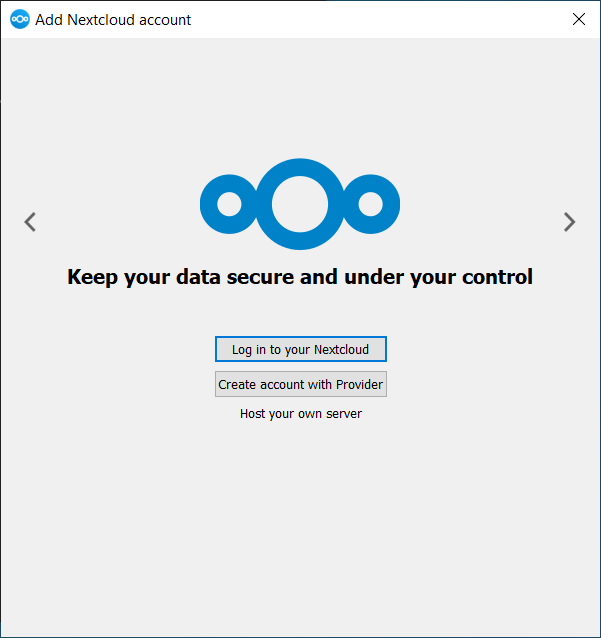
If you already have an account on a Nextcloud instance, click Login to your
Nextcloud. If you do not yet have a Nextcloud instance or an account, you may
need to create one first. Alternatively, you might want to register an account
with a provider. Press Create account with Provider in that case.
Note
The desktop client build you are using may have been built without provider support. In that case, you won’t see this page and will immediately see the next page.
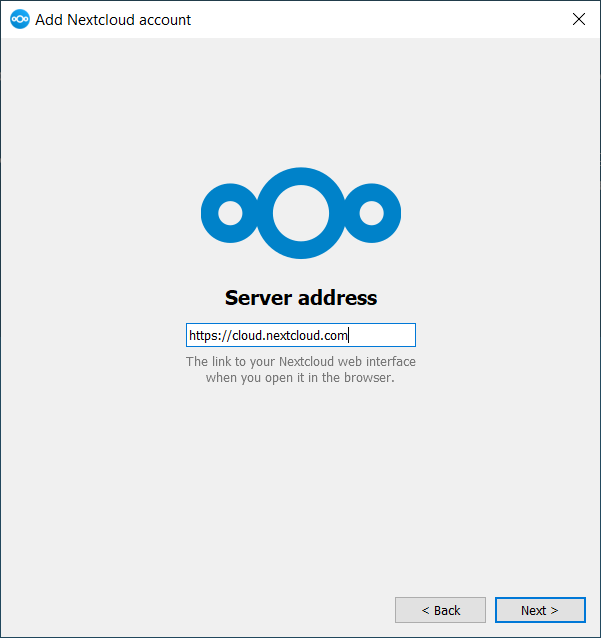
Enter the URL for your Nextcloud instance. The URL is the same URL that you type into your browser when you try to access your Nextcloud instance.
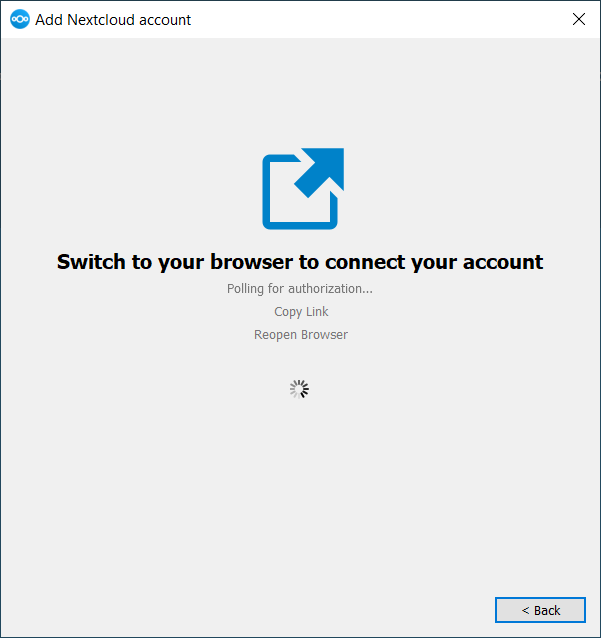
Now your web browser should open and prompt you to log in to your Nextcloud instance. Enter your username and password in your web browser and click Grant access when prompted. After you do that, go back to the wizard.
Note
You might not need to enter your username and password if you are already logged in to your web browser.
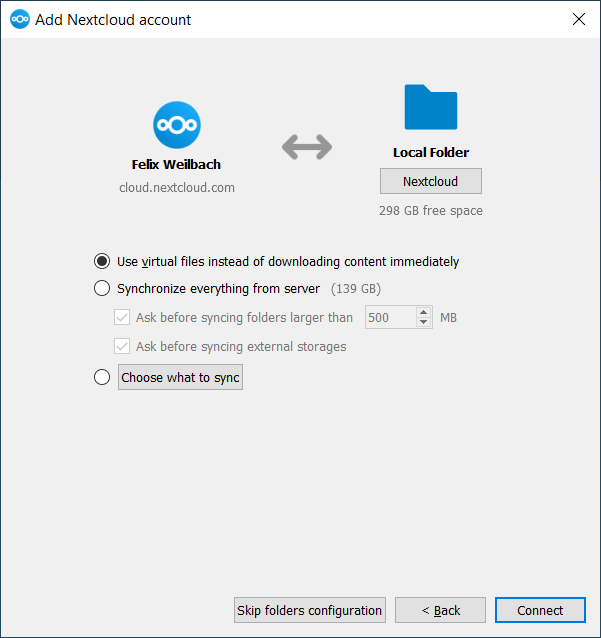
On the local folder options screen, you may sync all of your files on
the Nextcloud server, or select individual folders. The default local
sync folder is Nextcloud, in your home directory. You may change
this as well.
When you have completed selecting your sync folders, click the Connect button at the bottom right. The client will attempt to connect to your Nextcloud server. If it is successful, the wizard will close itself. You can then observe the sync activity and open the main dialog by clicking on the tray icon.